As an educator, I hear it all the time. Students are less prepared than they used to be. Curriculum is less rigorous. But is there any data to back this up? As it turns out, there is!
In a previous post, I took a look at nationwide reading and math scores for 4th and 8th graders. These scores are falling, especially among the bottom quartile of students. This post will look at a report from the University of California, San Diego, and some data from the University of Minnesota, Twin Cities.
Admissions Report from UCSD
UC San Diego published a report in November, which highlights insufficient math preparation of admitted students as an urgent concern. You can browse the entire report, or just read some excerpts below.
All UC campuses use a testing and placement system to onboard incoming first-year students into the appropriate initial mathematics course for their background, so they can meet the requirements of their chosen major… The Mathematics Testing and Placement Group (MTP)… onboards all incoming first-year students who need mathematics for their major.
Between 2020 and 2025, the number of freshmen whose math placement exam results indicate them not meeting high school standards grew nearly thirtyfold, despite all of these students having taken beyond the minimum UCOP required math curriculum, and with high grades. In the 2025 incoming class, this group constitutes roughly one-eighth of our entire entering cohort. Moreover, more than 70% of these students are also not meeting middle school standards.
In Fall 2024, the numbers of students placing into Math 2 and 3B surged further, with over 900 students in the combined Math 2 and 3B population, representing an alarming 12.5% of the incoming first-year class (compared to under 1% of the first-year students testing into these courses prior to 2021).
The report highlights that students’ transcripts and grades are poor predictors of preparedness:
Our fundamental challenge is the lack of reliable predictive information about mathematics preparation in all applicant files since the abandonment of the SAT [for the class entering in Fall 2021]
The quality of the information UC received from school transcripts became less reliable as a gauge of how well a student will succeed if admitted.
Of those who demonstrated math skills not meeting middle school levels… 42% percent complet[ed] Calculus or Precalculus, and another 44% whose last recorded high school math course was a Statistics class.
Grades achieved in high school math classes are not helping UC to evaluate math skills much more either… In 2024, over 25% of the students in Math 2 had a math grade average of 4.0.
Just to repeat: these are students who have straight A’s in high school math, but are falling short of middle school standards.
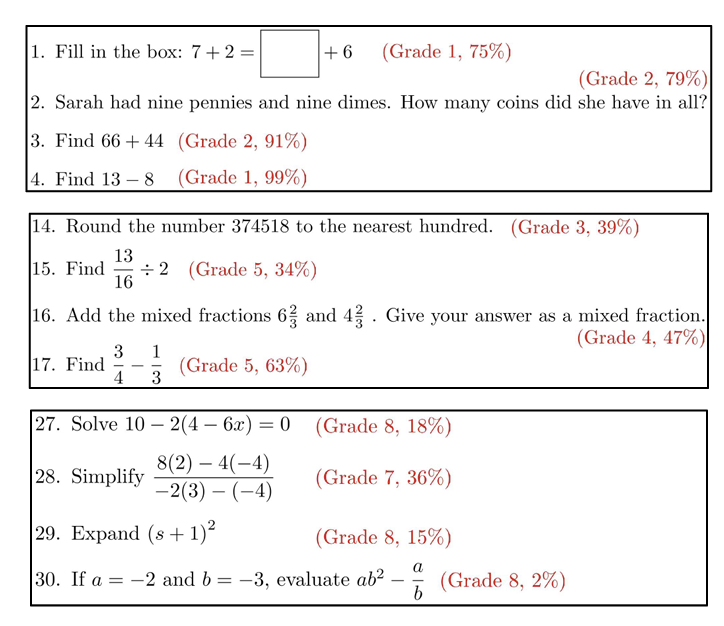
To illustrate, here are 12 questions from a 30-question, 45 minute exam given to 138 students who placed into the most remedial class. The numbers in red show the grade level of the question, and the percentage of these 138 college students who answered correctly.
I read a reaction to this report written by Kelsey Piper. Here are a few of her comments, which resonated with me:
I hope by now you are a tenth as infuriated on behalf of these students as I am. Because let’s recap: These students attend public schools. They work hard; they care about their class rank; they get good grades.
These kids were not doing anything wrong. They were lied to. They were told that they were prepared for classes they were not prepared for. They were told that they were excelling in classes that they were not excelling in. They deserved better.
“The ones who have been top all the way through have no reason to think they aren’t ready,” the math teacher told me. After all, they get an A every year. Doesn’t that mean they have mastered the material? But it doesn’t.
Furthermore, to the parents reading this: Your child’s good grades may mean nothing. Parents, understandably, tend to assume that if their kid is getting A grades, that means they are learning. I am here to deliver bad news: it doesn’t. It is very possible that your child who is bringing home straight As is catastrophically behind in one or more subject areas.
I feel pretty confident that if we had actually allowed them to fail earlier, thereby providing them with an adequate education during middle and high school, they would, in fact, be prepared to excel in college.
Data from the University of Minnesota
These problems are not limited to UCSD; it’s just that the UCSD report is much more open about it. However, similar trends are visible at the University of Minnesota. Here, freshmen in the College of Science and Engineering (CSE) typically enroll in a calculus sequence (which some advanced students place out of). Students are asked to take a placement exam over the summer, to ensure that they are adequately prepared. Based on this exam, here is a graph showing the percentage of the incoming class that is not ready to take calculus.
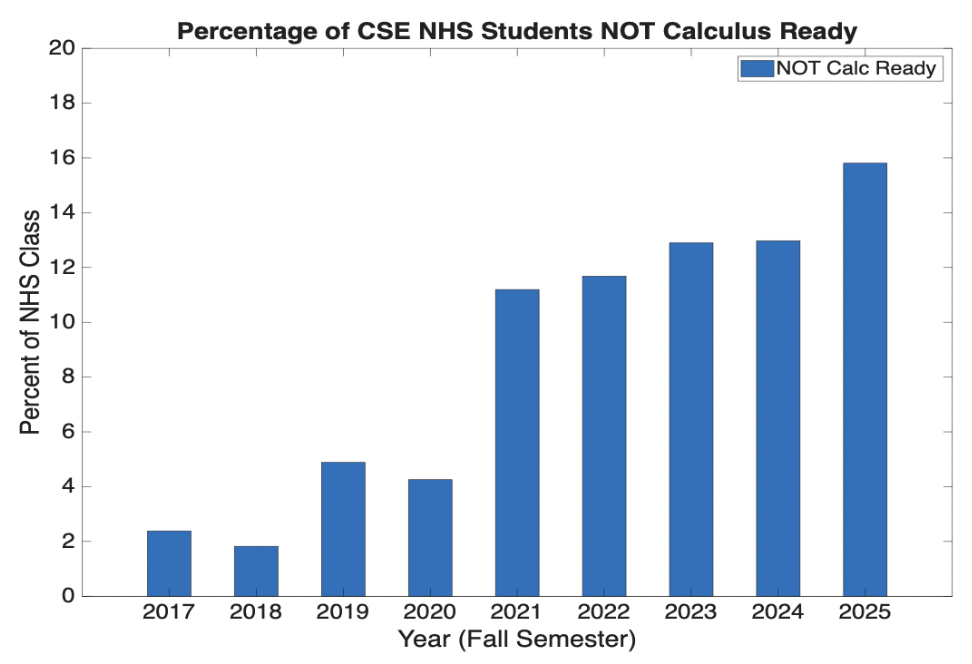
In 2017 and 2018, about 2% of the entering class was not ready for calculus. This jumped dramatically in 2021, and has continued rising. Last year, it was almost 1/6 of the entering class (over 250 students)!
For additional context, these are students who self-selected into the college of science and engineering (and were admitted). Further, the results are based on a self-administered online exam that uses the honor system. As such, these numbers should be treated as lower bounds on the number of students who are not prepared for calculus.
The presentation where I saw this graph also discussed many of the themes that came up in the UCSD report: GPAs of entering students are flat or rising, grades (even grades in math classes) are not great predictors for who will do poorly on the exam, and SAT or ACT scores have not been required for students entering in 2021 and beyond. (Apparently approximately half of admitted students in 2025 did not submit these scores.)
Closing Thoughts
It’s a lot easier to say “there’s a problem” than to solve it. But it seems that the level of math preparation of incoming freshmen has fallen dramatically over the past 6-7 years. While I am not glad to see this trend, I comment UCSD and UMN for measuring it, naming it, and taking steps to address it.
Both schools are rolling out more remedial math courses to help these students get caught up. I support these efforts, but I wonder if it is too little, too late. It’s one thing if students need to brush up on what a logarithm is, but quite another if they are struggling with basic elementary and middle school math. It will be hard to get these students to be prepared for college level material.
Another step that I wouldn’t be surprised to see (and would support) is a return to requiring standardized test scores (SAT or ACT). My sense is that these scores would be significantly more informative of college readiness than GPA.
Using standardized tests in admissions could help individual colleges and universities identify students who are more prepared, but it won’t address the underlying issue that many students are graduating with good grades but few skills. I agree wth Kelsey Piper that this is a failure of our education system, and that we need more early indicators (such as Mississippi’s 3rd grade Reading test) to identify struggling students and measure system-wide performance.